
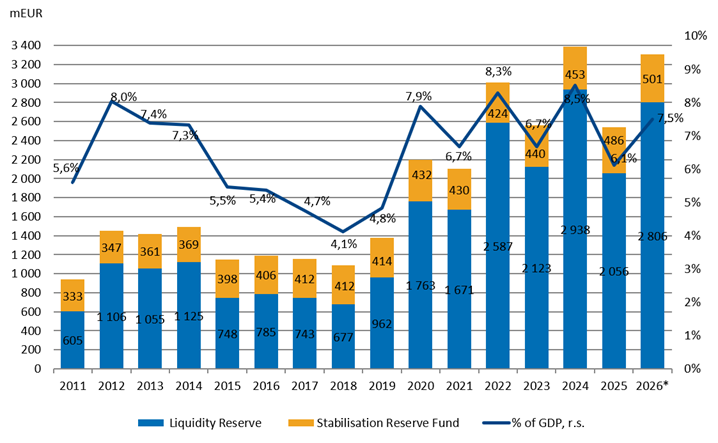
The State has two main financial reserves:
Stabilisation Reserve Fund
for funding any crisis situations only upon Parliaments' decision.
read more
The State Treasury applies conservative investment principles in managing the State’s financial reserves. For the Liquidity Reserve the liquidity and the preservation of value of financial assets considered more important than returns. For the Stabilisation Reserve Fund on the other hand, it is important in the long-term to maximise the value of financial assets while preserving sufficient liquidity. The States’ financial reserves are invested in liquid European government and financial sector bonds, and short-term deposits with low credit risk. In addition to the above, the financial assets of the Stabilisation Reserve Fund have been invested in exchange-traded funds. An overview of investment principles and management of financial risks can be found here.
Contact details
Consolidated cash management
The State Treasury centrally manages the daily cash flows of ministries and agencies, State-owned foundations (such as museums, theatres, hospitals) and social security funds. Cash management was centralized for ministries and agencies in 1996 when a Treasury Single Account (TSA) system was set-up by the State Treasury, with the consolidation of State-owned foundations’ and social security funds’ cash balances into the TSA system taking place in 2011 and 2012.
The objective in expanding the TSA coverage was to increase synergies in central and general government consolidated cash management (i.e., balancing the positive and negative cash flows of different entities), to reduce borrowing needs and interest costs for the State, while improving liquidity and enhancing financial risk management.
Consolidated cash management has a positive impact on the central and general government sector too: (i) social security funds and State-owned foundations do not need to carry out their own liquidity management or financial risk management as both are done centrally by the State Treasury; (ii) the State Treasury covers most bank fees; and (iii) they earn interest on their cash balances - the interest rate equals the return achieved on the overall Liquidity Reserve. Social security funds and State-owned foundations never suffer losses even if the return on the Liquidity Reserve is negative.
Cash flow management for the State is complex: cash managers need to take into account large intra-month mismatches of budgetary cash inflows and outflows, seasonality of cash flows, and cash flows of all entities for which the State Treasury manages their financial assets.
Borrowing needs for the State are planned based on short- and long-term cash flow forecasts in order to ensure that ministries, agencies, social security funds and State foundations can make their payments in full and on time. Cash flow forecasts include all revenues (taxes, grants received, sale of assets, etc.), expenditures (salaries, pensions, goods and services, investments, grants given, etc.) and financial transactions (increase of capital in state-owned companies, debt repayments, etc.) of all TSA members. Based on these cash flow forecasts, the net funding gap or cash surplus for various periods is calculated.
Last updated: 06.08.2026

