
The use of ALM approach results in improved management of the overall financial risks of the State, as well as minimising costs (for instance, by avoiding the situation where one set of transactions are carried out for debt management purposes and an opposite set of transactions are carried out for asset management purposes). The State Treasury manages two financial reserves: the Liquidity Reserve that is used for day-to-day cash management and the Stabilisation Reserve Fund for funding any crisis situations. The Stabilisation Reserve is not included in this ALM approach as it is not available for day-to-day use.
For debt management, the aim is to keep the cost of servicing the debt as low as possible while ensuring that the risks arising from the debt (primarily interest rate and refinancing risk) are kept at an acceptable level in terms of the State’s short-term and long-term risk-bearing capacity.
The State Treasury can use derivatives such as forwards, futures, swaps and options only for hedging purposes, not for speculative or trading purposes. Futures may only be used for interest rate risk management. It is not permitted to sell (‘write’) options or to trade options. In practice, the State Treasury does not use derivatives (e.g. interest rate swaps for debt management) at present, except FX forwards for short-term exchange risk management.
The Government has approved consolidated financial risk management principles for both the financial assets and liabilities of the Ministry of Finance (the document in Estonian).
| Debt Portfolio | Liquidity Reserve | Stabilisation Reserve Fund | ||||
|---|---|---|---|---|---|---|
| 31.12.2025 | 30.06.2026 | 31.12.2025 | 30.06.2026 | 31.12.2025 | 30.06.2026 | |
| Amount | 7 312 million | 8 612 million | 2 056 million | 2 806 million | 486 million | 501 million |
| Modified duration | 3.88 years | 4.02 years | 0.3 years | 0.32 years | 3.46 years | 4.23 years |
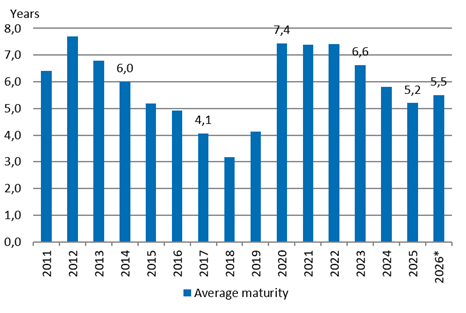
| Average term to maturity | 5.20 years | 5.50 years | ||||
| Average interest rate re-fixing period | 4.39 years | 4.59 years | ||||
| Currency | 100% EUR | 100% EUR | 100% EUR | 100% EUR | 100% EUR | 100% EUR |
| Composition | 15% short-term debt instruments, 64% Eurobond and 21% long-term loans | 14% short-term debt instruments, 66% Eurobond and 20% long-term loans | 43% bonds, 20% deposits and 37% cash | 56% bonds, 6% deposits and 38% cash | 83.27% bonds, 7.28% deposits, 9.28% exchange-traded funds and 0.17% cash | 89% bonds, 10.9% exchange-traded funds and 0.1% cash |
The State Treasury continually manages and monitors its financial risks:
Liquidity risk refers to a situation where the volume of liquid assets diminishes quickly as a result of unanticipated cash flow obligations and/or a possible difficulty in raising cash quickly by borrowing.
- For liquidity management, the maximum maturity of term deposits and reverse repos is 92 days. The maximum maturity is shorter for the Liquidity Reserve’s term deposits in local banks with ratings less than P1.
- Money can only be invested into bonds where the issue size is at least EUR 1 billion and where the investment is a maximum 10% of the total issue size and there is an active secondary market.
-
For liquidity risk management, a minimum liquidity requirement was introduced and committed credit facilities with the main local partner banks were established in 2011. The minimum required level of the liquidity position equals the State’s six-month negative net cash flow comprising: (i) transactional requirements, meaning the excess of budgeted monthly outgoings over budgeted revenue, monthly outgoings of the Health Insurance Fund and the Unemployment Insurance Fund (whose cash management is consolidated with central government) and monthly debt and interest payments, and (ii) precautionary requirements, representing an estimate of the deterioration in budgeted tax revenues over the following six months in the event of an economic downturn of the severity experienced in 2009 and a provision for liabilities from guarantees given by the State that are expected to crystallise in the following six months.
The actual liquidity position is calculated as (a) the Liquidity Reserve (deposits with maximum three months maturity, current accounts and bonds, liquid and high-grade) plus (b) undrawn amounts from facilities committed for at least the following three months (by banks). These facilities also serve to mitigate operational risks and to ensure that unexpected large outgoing payments can be made without having to liquidate investments.
Foreign currency exposures can be at most 1% of the Liquidity Reserve. The State Treasury can do on-lending and also borrow in foreign currency provided that the total foreign currency exposure does not exceed 1% of the Liquidity Reserve. No exchange rate risk is permitted in the Stabilisation Reserve Fund.
Interest rate risk refers to the risk of changes in the value of the financial reserves and in the cost of debt arising from changes in interest rates.
Benchmarks are used for both the Liquidity Reserve and Stabilisation Reserve Fund in order to measure their investment performance.
The benchmark for the Stabilisation Reserve Fund consists of three parts – money market, bonds and exchange-traded funds. The money market and bond part of the benchmark for the Stabilisation Reserve Fund is derived from the interest rate of A- to AAA Eurozone government bonds and short-term deposits, so that with 95% probability during the next three years the return of the benchmark is non-negative (i.e., that the assets do not lose nominal value).
The interest rate risk of the money market and bond part of the Stabilisation Reserve Fund is measured on a VAR (value-at-risk) basis, with a VAR limit.
The benchmark for the Liquidity Reserve is a 1-month €STR swap rate with monthly fixings.
During the second quarter of 2020, the level of government debt increased significantly due to the government response to tackle the spread of COVID-19 and to support the economy. This meant that the previous policy, based on an ALM approach for a situation where financial assets exceeded liabilities, was no longer appropriate. Therefore, the the principles of interest rate risk management were revised.
The principles for interest rate risk management of the financial assets (the Liquidity Reserve and the on-lending portfolio) remains unchanged – the modified duration of these financial assets must not exceed 0.45 years.
The interest rate risk of the outstanding debt is measured using the average interest rate re-fixing period method. Two separate limits are in place: (i) the average interest re-fixing period of any outstanding debt up to EUR 800 million cannot exceed 0.5 years (i.e., a continuation of the ALM-principle as discussed above) and (ii) the average interest re-fixing period of any outstanding debt over EUR 800 million must exceed 3 years, with the maximum interest re-fixing period set periodically by the Minister of Finance based on the State’s long-term risk-bearing capacity. As of 30 June 2026, the weighted average interest re-fixing period of the total debt portfolio was 4.59 years.
Credit risk is the risk of non-performance by a counterpart in a financial contract.
The Liquidity Reserve can be invested in bonds and term deposits only where the issuer’s or issuer's parent company's credit rating is at least Aa3/AA-/AA- (Moody’s/Standard & Poor’s/Fitch) for long term investments. For the Stabilisation Reserve Fund, the constraints are A3/A-/A-, respectively. For short term investments of the Liquidity Reserve and the Stabilisation Reserve Fund, the issuer’s, credit institution's or credit institution's parent company's credit rating is at least P-1/A-1/F-1 (Moody’s/Standard & Poor’s/Fitch). For the Liquidity Reserve’s deposits in those local banks through which the State Treasury routes or receives payments, this is relaxed somewhat. There is no limit for AAA-rated investments in government or International Financial Institutions’ bonds or for cash held at central banks.
Exposure to a single counterparty can be a maximum of 20% of the financial reserves.
Investments in highly rated government bonds must be at least 65% of the Stabilisation Reserve Fund.
Financial reserves cannot be invested in ESM and EFSF bonds as Estonia is one of the guarantors of these institutions. The assets of the Stabilisation Reserve Fund are not allowed to be invested in the banks whose deposits are guaranteed in accordance with the Guarantee Fund Act.
Refinancing risk is the risk that debt will have to be refinanced at an unusually high cost or, in extreme cases, cannot be refinanced at all.
- For managing refinancing risk, outstanding short-term debt (maturity under 1 year) cannot exceed 25% of the State’s budgeted expenditures (total of costs and investments).
- The repayments of long-term debt obligations (final maturity greater than 1 year) should be spread out so that the annual repayments of debt are not more than 5% of the forecasted GDP each year.
Market risk is the risk that changes in stock market prices will affect the value of financial assets and liabilities.
-
The market risk of the Stabilisation Reserve Fund is managed using the benchmark.
-
When investing the Stabilisation Reserve Funds, market risk is not taken on the part of the exchange-traded funds.
Last updated: 06.08.2026
