
The Liquidity Reserve has two main tasks:
- It is the financial buffer for the State’s daily cash flow management to deal with normal mismatches of cash inflows and outflows within a month. At the beginning of each month the balance decreases due to pension, benefits and salary payments; it then increases on tax payment days, mainly on the 10th and the 20th day of a month.
- It includes an additional risk buffer to deal with unanticipated fluctuations in cash flows.
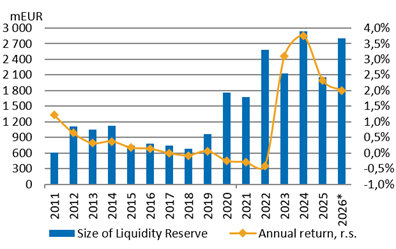
The Liquidity Reserve also helps cash managers to mitigate the impact of temporary cash shortfalls from normal cash flow seasonality, and of any one-off financing transactions (e.g., an increase in share capital in a state-owned company) so that there has been no need for the State for short-term borrowing from financial markets.
The Liquidity Reserve is invested in short-term deposits and liquid bonds with low credit risk. The maximum average duration of the portfolio is 5 months and the benchmark is the 1-month €STR swap rate with monthly fixings.
The size of the Liquidity Reserve must comply with the minimum liquidity requirements set by the government. An overview of the liquidity requirements, investment principles and regulations on financial risk management for the State Treasury can be found under the Financial Risk Management.
Investment reports for the Liquidity Reserve
Last updated: 06.08.2026
