
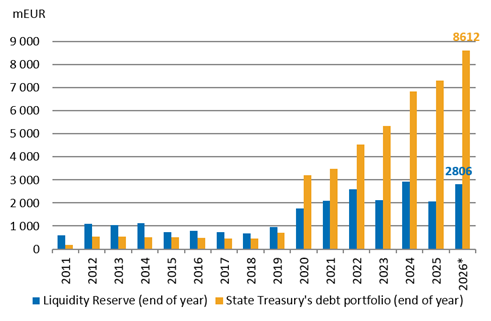
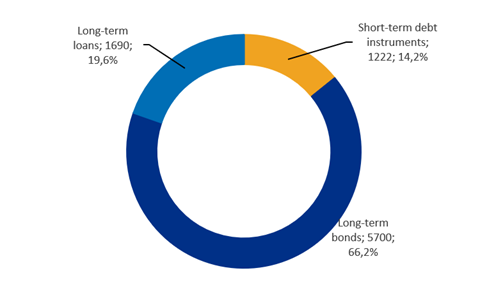
For a long time, the State Treasury's debt obligations were at a level similar to financial reserves. The trend changed with the outbreak of COVID-19 in the beginning of 2020. The war in Ukraine that started in 2022 and coping with the energy crisis further increased the state's borrowing needs. The amount of outstanding debt obligations consists of short-term debt instruments (T-bills and ECPs), long-term bonds (Eurobonds, domestic bonds) and long-term loans (from EIB, NIB, CEB and SURE). Although the State Treasury is not active in debt management, it has to be ready to borrow quickly if needed – several committed credit lines with banks that can quickly be drawn upon in case of need to safeguard the State’s ability to make payments can be put in place.
State Treasury’s Debt Reports
Annual borrowing and debt reports provide an overview of State Treasury’s borrowing activities throughout the year and the outstanding debt portfolio as of year-end. Read more here.
The quarterly debt reports provide an overview of the structure of the state treasury's debt obligations, its change compared to the end of the year, and the main risk indicators.
Central government and general government debt
Statistics usually compare general government debt levels between countries, rather than central government debt levels. Often the central government is the biggest borrower in a country.
At the end of 2025, the Ministry of Finance had EUR 7 312 million of outstanding debt (73% of total general government debt). Note that the State guarantee of the EFSF’s debt obligations (5% of total general government debt in 2025) is, for statistical purposes, also considered to be part of the central government debt. Estonia has not paid any funds to cover its EFSF debt obligations.

Last updated: 06.08.2026

